
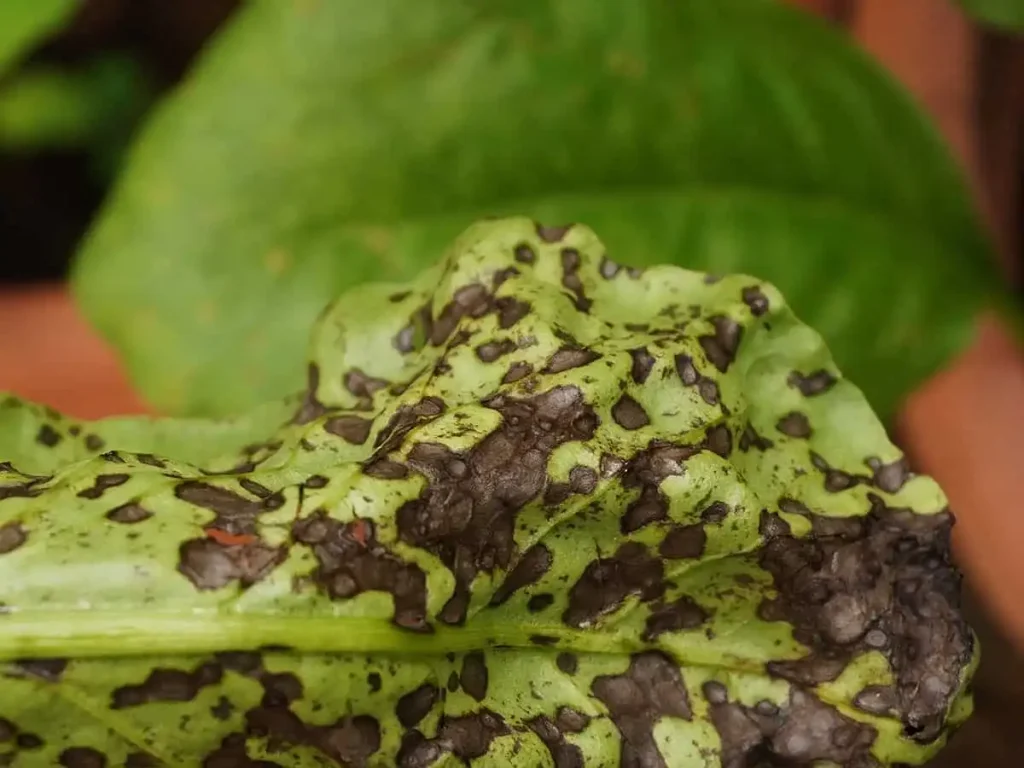
Have you seen these weird brown, black or yellow blemishes on your plant? This is the “leaf spot” disease that many of us plant lovers deal with when we have indoor plants. Being a decorative piece, a house plant should be beautiful; however, treat leaf spot disease and green to being completely ruined with spots all over them. If untreated, these spots could lead to your plant dropping its leaves, not growing to its fullest potential and/or dying altogether.
The good news is that leaf spot diseases are easy to treat! When treated early, you will be able to treat them naturally without using chemicals. In this complete guide on how to identify and treat leaf spot includes: what causes leaf spot, how to identify bacteria vs. fungi types of leaf spots, how to treat leaf spot by following proven steps; any home remedies – baking soda or neem oil; prevention tips; and an easy-to-read troubleshooting reference table. No matter if your monstera, pothos, peace lily or philodendron plant is affected, this information will assist you on how to bring your house plants back to life.
Let’s get those leaves saved and get our house plants thriving again!
Treat Leaf Spot Disease; Step-By-Step
Step 1: Identify and Isolate – First Critical Move
Early detection of leaf spot? To prevent the plant from spreading, isolate it right away.
Warning signs to look out for:
- Small black or brown spots with yellow haloes (fungi frequently have tiny black dots or concentric rings).
- Browning of water-soaked lesions (bacterial).
- spots that combine to form bigger blotches.
- Curling, dropping, or yellowing of the leaf.
In contrast, there are no pests (no webbing or holes) or nutrient burn (even brown edges).
quarantine in a distinct space with adequate ventilation.
Step 2: Remove Infected Parts – The Most Important Treatment Step
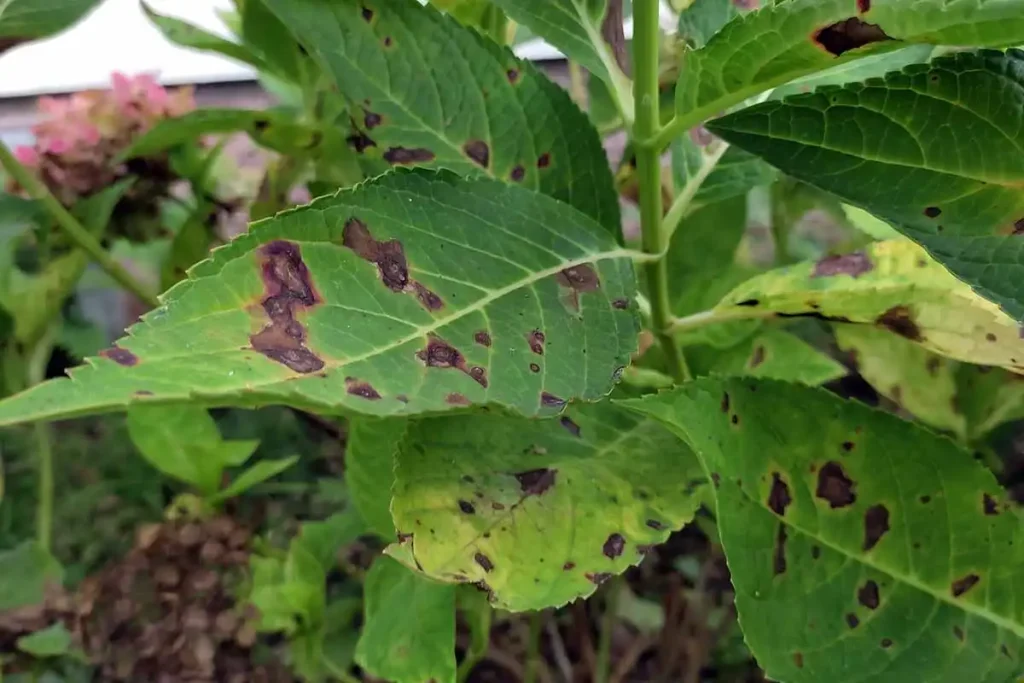
Prune away all spotted leaves/stems with clean, sharp scissors (wipe blades with rubbing alcohol between cuts).
- Cut at the base of the leaf petiole or stem.
- Dispose of clippings in trash (never compost!).
- Sanitize pot rim and tools.
This removes most fungal spores/bacteria and stops progression. Many plants recover fully after pruning if conditions improve.
Step 3: Improve Growing Conditions – Starve the Disease
Leaf spot loves humidity and wet leaves – change the environment!
- Air circulation: Use a small fan on low; space plants apart.
- Watering: Water from base only (no overhead); let top 1-2 inches dry. Use room-temperature water.
- Humidity & light: Reduce misting; provide bright indirect light (helps dry leaves faster).
- Pot & soil: Ensure good drainage; repot into fresh, sterile mix if root issues suspected.
These cultural fixes often resolve mild cases without sprays.
Step 4: Proven Natural Treatments for Leaf Spot
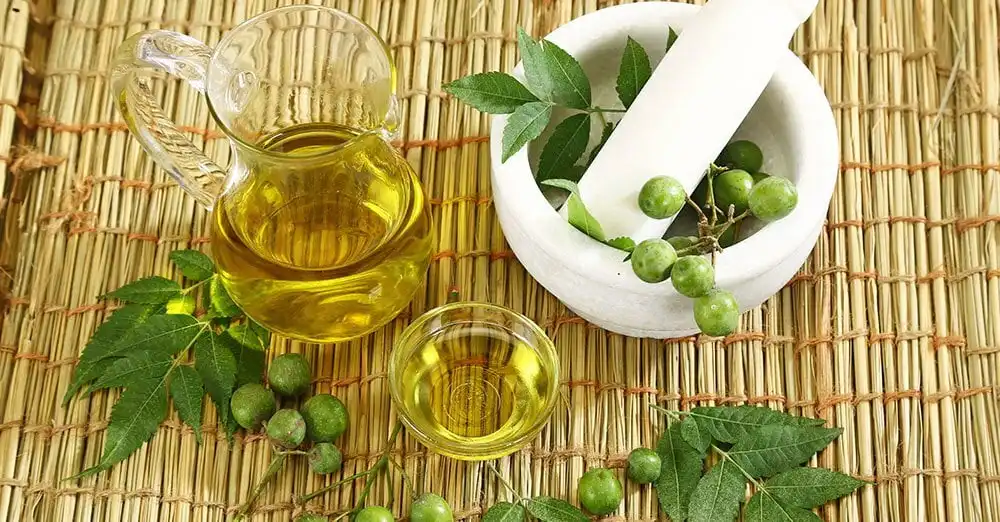
Organic & Home Remedies (Safe for Indoors)
- Baking Soda Spray (Great for fungal leaf spot)
- Mix 1 tsp baking soda + ½ tsp mild liquid soap (like Castile) in 1 quart water.
- Spray upper/lower leaves every 7-10 days.
- Raises pH to inhibit fungi; test on one leaf first (can cause burn in high doses).
- Neem Oil (Broad-spectrum antifungal + pest control)
- Dilute per label (usually 1-2 tsp neem + ½ tsp soap in 1 quart water).
- Apply evenings; repeat weekly.
- Smothers spores; repels pests that spread disease.
- Milk Spray (Preventive & mild treatment)
- Mix 1 part skim milk + 2-3 parts water.
- Spray weekly; proteins boost plant immunity.
- Hydrogen Peroxide (For bacterial spots)
- Dilute 1 part 3% H2O2 to 4 parts water.
- Spray or wipe leaves; oxygen kills bacteria.
- Copper Soap/Fungicide (Organic-approved for severe cases)
- Use labeled houseplant versions; follow directions.
Apply treatments in morning/evening; ensure good ventilation. Combine with pruning for best results.
Step 5: Prevention – Keep Leaf Spot Away Forever

- Quarantine new plants 2-4 weeks.
- Avoid wetting foliage; bottom-water.
- Use sterile pots/soil; clean tools.
- Maintain moderate humidity (40-60%); use pebble trays wisely.
- Fertilize balanced (avoid excess N).
- Monitor weekly – early removal stops outbreaks.
Troubleshooting Leaf Spot Issues: Quick-Reference Table
Here’s a handy table for common scenarios:
| Problem / Symptom | Likely Cause | Immediate Action | Long-Term Prevention |
|---|---|---|---|
| Brown/black spots with yellow halo | Fungal leaf spot | Prune infected leaves; isolate plant | Improve airflow; avoid overhead watering |
| Water-soaked spots turning brown | Bacterial leaf spot | Remove affected parts; use H2O2 or copper soap | Sanitize tools; reduce humidity; no misting |
| Spots spreading rapidly | High humidity + poor air circulation | Prune heavily; use fan; apply neem/baking soda | Space plants; increase light; lower humidity |
| Leaves yellowing after spots | Nutrient stress or severe infection | Check roots; repot if needed; fertilize lightly | Balanced care; avoid overwatering |
| No improvement after treatment | Persistent fungal strain or root issue | Repot in fresh soil; try stronger organic fungicide | Rotate treatments; monitor environment |
| Spots on new growth only | Recent infection or pest vector | Inspect for pests; prune new spots | Quarantine new plants; neem preventive spray |
| Foliage drop after treatment | Shock from pruning/treatment | Reduce stress; maintain stable conditions | Gradual changes; prune in stages |
| Recurring spots | Contaminated soil/pot or environment | Repot sterile; clean area | Improve drainage; regular inspections |

Final Thoughts: Bring Your Houseplants Back to Life!
Your indoor jungle doesn’t have to be destroyed by leaf spot disease. Most houseplants recover well with natural treatments like neem or baking soda sprays, pruning, improved airflow, and rapid isolation.
Examine your collection first thing today to find the simplest wins by identifying problems early. Your peace lily or monstera will appreciate it with new, spotless leaves!
Have you previously dealt with leaf spot? Which treatment did you find most effective? Let’s support one another in maintaining the health of our houseplants by leaving comments with advice or pictures of our plants!
Have fun being a plant parent!


